Garland UK 2025 Sustainability Report
Authored by
Charlotte Fenwick
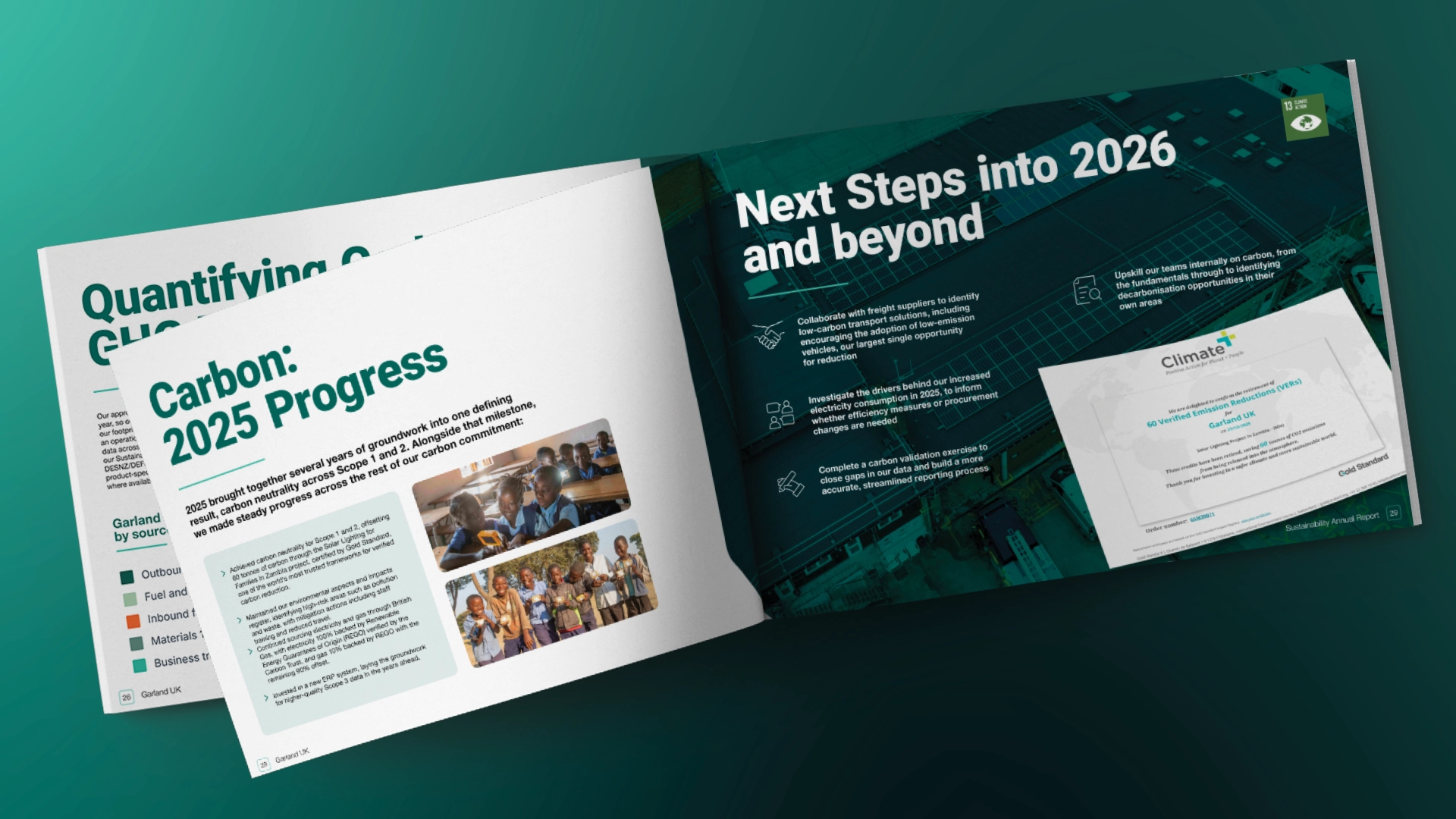
Garland UK is proud to publish its 2025 Sustainability Report, marking a defining milestone in our journey towards net zero. In 2025, we achieved carbon neutrality across Scope 1 and 2 emissions.
As Mark Fisher, General Manager, explains, “In 2025, Garland UK achieved carbon neutrality across Scope 1 and 2 emissions, a goal we set out to reach and have now delivered through real, verified action. It is a moment that reflects years of disciplined data collection, supplier engagement and operational change, and it sets a new benchmark for what our industry should expect of itself.”
Now in our third year of formal reporting, this year’s report reflects a business that is building on solid foundations rather than starting from scratch. It sets out what we have achieved, where progress has been harder to find, and what we are focusing on next.
A landmark year for carbon
Total emissions fell to 287,064 tCO2e in 2025, a 4% reduction year on year and 12% below our 2023 baseline. Scope 1 emissions are down 18% since baseline, and Scope 3, which makes up 99% of our footprint, is down 12%. Within that, business travel fell 37% on 2024 and inbound freight dropped 46%, both strong signals that the changes we made to freight and transport planning are working.
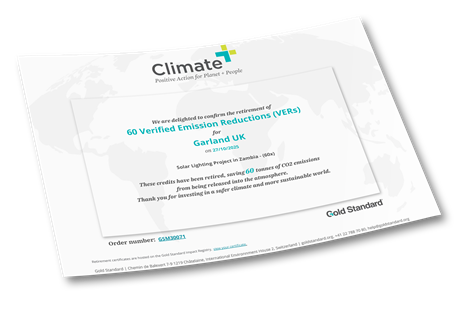
We reached carbon neutrality across Scope 1 and 2 by offsetting 60 tonnes of carbon through the Solar Lighting for Families in Zambia project, certified by Gold Standard, one of the world’s most trusted frameworks for verified carbon reduction. We also published our Carbon Reduction Plan in 2025, in line with the UK Government’s Procurement Policy Note 06/21, giving our public and private sector clients a clear, compliant view of how we are managing Scope 1, 2 and 3 emissions.
We took a considered decision this year not to pursue formal Science Based Targets initiative (SBTi) validation. Instead, we are keeping our targets tightly aligned with a 1.5°C pathway and reviewing them regularly against the latest science based guidance and UK government expectations, a framework that flexes as best practice evolves rather than locking us into a fixed validation process.
Chris Erhard, Lead Consultant at Action Sustainability, said, “Garland has once again displayed continuous improvement in delivering against their targets, set out within their sustainability strategy. This shows their commitment to decarbonisation and remains in line with the UN Environment Programme’s recommendations for staying on track to meet the Paris Agreement’s 1.5°C target.”
Not every trend moved the way we wanted. Outbound freight rose 9% since baseline and now accounts for 67% of our total footprint, and Scope 2 emissions increased 61% due to higher electricity consumption. We are not glossing over this. As Mark Fisher notes, “We know where our impact lies, predominantly in freight, and we are using that clarity to sharpen our focus for the years ahead rather than treating this as a finish line.” Freight remains our single largest opportunity for reduction and is the clear priority for 2026, while the rise in electricity use is being investigated so we understand what is driving it before it becomes a trend.
Helping clients choose systems with confidence
For anyone specifying a roof or rainscreen system or a solar installation, the environmental performance of what goes on the building matters as much as what happens in our own operations. In 2025 we extended our Environmental Product Declaration (EPD) coverage to 17 of our 18 core systems, giving specifiers independently verified data on carbon and resource impacts across the full lifecycle of our roofing, rainscreen and solar ranges.
Ben Whitemore, Head of Technical, said, “Reaching EPD coverage across 17 of our 18 systems means our customers no longer have to take our word for a product’s environmental performance, they can see it, verified and independently assessed. That transparency is what we believe specifiers should expect as standard, not as an exception.”
Honest reporting on waste
Garland UK maintained zero waste to landfill throughout 2025, including through a transition from Grundon to Veolia’s Energy from Waste scheme in October. But the headline numbers on waste volumes did not move in the direction we wanted. Total waste rose 53% on 2024 and our recycling rate fell 43%, largely the result of three planned warehouse clear-outs in February, June and July that removed a significant volume of dead stock, most of which could not be recycled.
Alongside these clear-outs, we kept our everyday waste reduction habits running, from repurposing damaged bituminous membrane into product samples to working with suppliers on packaging made from recycled materials. Our next steps into 2026 include developing practical guidance for teams on reducing over-ordering and unnecessary packaging, and working more closely with our waste provider and supply chain on alternative disposal routes.
Investing in our people
As a 100% employee-owned business, our people share this responsibility. In 2025, 100% of internal teams completed training on sustainability, environment and Fairness, Inclusion and Respect topics, and our Technical Managers delivered CPD sessions to 989 specifiers in person and a further 434 online.
We also launched our first employee wellbeing survey, achieving a 47% response rate, and contributed 108 hours of volunteering with FareShare South West, supporting the redistribution of surplus food to communities in need.
What this means for our customers
Mark Fisher explains why this work matters beyond the numbers, “This progress matters most in what it means for the people who specify, install and maintain the buildings we work on. Every improvement we make to our data, our materials and our supply chain is ultimately about giving surveyors, architects and estate teams a partner they can trust to deliver lasting, measurable value, not just compliant paperwork.”
He also points to the gap our sector faces, “Refurbishment and retrofit remain chronically underserved by sustainability frameworks built for new build. We believe our sector deserves better, and we intend to lead that change, raising the standard for what responsible roofing and building envelope work looks like across the UK.”
What’s next
Looking into 2026 and beyond, our priorities include working with freight suppliers to identify low-carbon transport solutions, completing a carbon validation exercise to strengthen our data across all three scopes, investigating the causes of our rising electricity use, and redeveloping our supplier engagement plan to better understand our supply chain’s sustainability capabilities. We are also refreshing our wider sustainability strategy, to be released in due course.
As Mark Fisher summarises, “We remain committed to transparency, to science-based action, and to delivering outcomes that our customers and communities can measure and rely on.”
Read the full 2025 Sustainability Report and see how Garland UK can support your journey to net zero.
More Blogs
Garland UK Achieves Scope 1 and 2 Carbon Neutrality
Garland UK has reached a major milestone in its sustainability journey, achieving carbon neutrality across Scope 1 and 2 emissions for the first time…
25 Years of Garland UK: Built on Opportunity, Ownership and Service
A significant milestone for Garland UK as we celebrate 25 years of delivering roofing and building envelope solutions across the United Kingdom…

Garland UK Offsets 60 Tonnes of Carbon with Solar Project
Garland UK has offset 60 tonnes of carbon through a solar lighting project in Zambia, supporting clean energy access as part of its ongoing sustainability commitment…